PPWR Regulation
AUGUST 2026
PPWR Declaration of Conformity (DoC) and technical file: what to include, and how to get it done now.
Still figuring out what PPWR actually requires from your team? You’re not alone. Here are the three things QA, Sustainability, and Packaging teams in F&B should know:

A Declaration of Conformity is required per packaging type, not per company. Each DoC must be signed and backed by evidence that holds up under inspection.

The technical file is what makes your DoC valid. Lab-verified PFAS and heavy-metal data, supplier documentation, and packaging specs all need to sit in one retrievable file.

Gathering lab data and supplier documentation takes time: the sooner you start, the sooner you close the gap and limit your risk of fines.

_gif.gif)
— Your compliance evidence, explained
DoC generation & Technical dossier preparation: What you need, and how to get there

Declaration of Conformity (DoC)
A DoC is a signed statement confirming that a specific packaging type meets PPWR requirements. You need one per packaging type, not one per company. As a DoC example: a food brand with several SKUs needs a separate DoC for every packaging type that differs.
What to do:

Confirm the substances, materials, and design meet PFAS and heavy-metal limits for that packaging type
Get sign-off from whoever holds the compliance role for that product (see roles & obligations below)
Keep a signed copy on file, producible within 10 days if requested
Technical file
The technical file is the evidence backing your DoC: lab results, supplier documentation, and packaging specs, all in one place. Without it, a signed DoC alone won't hold up under inspection.
What to do:
Gather lab-verified PFAS and heavy-metal test results per packaging type
Collect supplier documentation confirming material and substance compliance
Structure everything so it's retrievable
_gif.gif)
— Does this role apply to you?
Recognise your PPWR role.
Understand your responsibilities.
The PPWR assigns obligations by role, not by company type. The regulation defines separate PPWR roles: manufacturer, producer, importer and distributor. Most food compainess hold more than one PPWR role, depending on the product.
Fabrikant
Degene die verpakking of een verpakt product vervaardigt, of dit onder eigen naam of merk laat ontwerpen of produceren. Eén fabrikant per verpakkingseenheid, EU-breed.
Verplichtingen vanaf augustus 2026
-
Conformiteitsbeoordeling uitvoeren
-
EU-conformiteitsverklaring per verpakkingstype opstellen
-
Technische documentatie bijhouden (10 jaar bewaartermijn, binnen 10 dagen op verzoek beschikbaar)
-
Laboratoriumgeverifieerde PFAS- en zware-metalendata bewaren voor voedselcontactverpakking
Producent
De fabrikant, importeur of distributeur die de verpakking als eerste in een specifieke lidstaat op de markt aanbiedt. Dit is een geografisch criterium, niet gekoppeld aan het merk — per land kan een andere partij producent zijn voor dezelfde SKU.
Verplichtingen vanaf augustus 2026
-
Registreren bij het nationale EPR-register van die lidstaat
-
Verpakkingsvolumes rapporteren die op de markt zijn gebracht
-
EPR-bijdragen betalen aan een producentenverantwoordelijkheidsorganisatie
Importeur
Een in de EU gevestigde partij die verpakking of een verpakt product van buiten de EU voor het eerst de EU-markt op brengt.
Verplichtingen vanaf augustus 2026
-
PFAS-, zware-metalen- en etiketteringscompliance controleren vóór marktintroductie
-
Een kopie van de DoC bewaren (binnen 10 dagen te tonen)
-
Registreren bij EPR-regelingen in elke lidstaat waar wordt verkocht
-
Dezelfde stofcompliance-verplichting dragen als de fabrikant
Distributeur
Iedere partij in de keten, anders dan de fabrikant of importeur, die verpakking op de markt aanbiedt.
Verplichtingen vanaf augustus 2026
-
Verifiëren dat de fabrikant/importeur aan hun verplichtingen heeft voldaan vóór doorverkoop
-
Controleren of etikettering correct is en geen tekenen van non-conformiteit vertoont
-
Traceerbaarheid bijhouden van wie wat heeft geleverd
-
Nooit herlabelen of herverpakken zonder de volledige fabrikantverplichtingen op zich te nemen
Gemachtigde vertegenwoordiger
Een in de EU gevestigde partij die schriftelijk is aangesteld door een producent zonder EU-vestiging, om de EPR-registratie en -rapportage in een lidstaat namens hen te verzorgen.
Verplichtingen vanaf augustus 2026
-
De niet-EU producent registreren bij het nationale EPR-register
-
Volumerapportages en EPR-bijdragen namens de producent indienen
-
Optreden als compliance-contactpersoon voor die lidstaat

Most F&B businesses hold more than one role across their product range. A food brand that sells products under its own name is a producer for those SKUs. If it also sources packaged goods from outside the EU, it is an importer for those lines. If it resells a third-party branded product without modification, it acts as a distributor for that product. Your role is determined product by product — not once for the whole business. Mapping your role per SKU is the first step in any PPWR compliance process.


Whitepaper download
18 pages
Unpacking the PPWR: the complete guide for food and consumer goods
Everything QA, packaging and sustainability teams need in one document: every role, every deadline, every requirement — with a practical preparation checklist.
PFAs & heavy-metal requirements explained
Declaration of Conformity walkthrough
EPR registration by Member State
Step-by-step preparation checklist
F&B-specific examples throughout


PPWR SURVEY RESULTS
22 pages
How prepared is food and consumer goods industry for PPWR?
PPWR August 2026: now in force. Here's how the food industry is responding.
35% average confidence scroe in PPWR readiness
49% indicated suppliers don't respond or are slow to reply
38% PPWR ownership sits solely within Quality Assurance
4 extra hours a week lost to compliance busywork.
F&B-specific examples throughout
Van kracht vanaf augustus 2026 · Verpakkingen met voedselcontact
Wat betekent dit in de praktijk:
Een saladebak of sandwichwikkel voor kant-en-klare producten mag vanaf augustus 2026 niet meer op de EU-markt worden gebracht als de verpakking PFAS bevat boven de wettelijke limieten. Kartonnen bakjes en papieren wraps gebruiken vaak PFAS-coatings om vet en vocht tegen te houden. Iedere verpakkingscomponent vereist laboratoriumtesten. Alleen leveranciersverklaringen zijn niet voldoende.

PFAS-limieten in voedselcontactverpakkingen
Maximale drempelwaarden: 25 ppb per individuele niet-polymeergebaseerde PFAS, 250 ppb voor de totale som en 50 ppm totaal fluor. Geldt voor iedere verpakking die direct of indirect contact heeft met voedsel, inclusief papier, karton en flexibele laminaten.
Van kracht vanaf augustus 2026 · Alle verpakkingstypes
Wat betekent dit in de praktijk?
Een fel bedrukte buitenkartonnen doos of foliedeksel met metallic inkten kan de limieten overschrijden, zelfs wanneer de binnenste voedselcontactlaag schoon is. Iedere laag van een meerlaagse verpakking moet worden gecontroleerd, niet alleen het binnenste oppervlak.

Limieten voor zware metalen in alle verpakkingen
De gecombineerde concentratie van lood, cadmium, kwik en zeswaardig chroom moet onder de 100 mg/kg blijven voor ieder verpakkingstype, niet alleen voedselcontactverpakkingen. Dit geldt voor inkten, pigmenten, coatings en lijmen die in productie worden gebruikt.
Van kracht vanaf augustus 2026 · Verplichting voor producenten
Wat betekent dit in de praktijk?
Een zuivelmerk met 80 SKU's verdeeld over 12 verschillende verpakkingstypes heeft 12 DoC's nodig, elk ondersteund door leveranciersgegevens en laboratoriumbewijs. Iedere materiaalwijziging, zoals een andere kartonleverancier of gewijzigde coatingspecificaties, vereist een update van de DoC.
Uitbesteden van productie draagt deze verplichting niet over.

Declaration of Conformity per verpakkingstype
De producent moet voor ieder uniek verpakkingstype een DoC opstellen, ondertekenen en bewaren. Deze moet verwijzen naar de specifieke PPWR-vereisten waaraan wordt voldaan, gegevens over materiaalsamenstelling bevatten en worden bijgewerkt zodra de verpakking verandert.
Van kracht vanaf augustus 2026 → februari 2027
Wat betekent dit in de praktijk?
Voor een co-packer die F&B-verpakkingen produceert onder het label van een retailer, moeten de naam en het adres van de retailer op de verpakking staan. Niet die van de co-packer. Verpakkingen die nu zonder deze informatie worden besteld, vereisen vóór de deadline aanpassingen aan artwork en drukplaten.

Etikettering & digitale identificatie op de verpakking
Vanaf augustus 2026 moet de verpakking de naam en het adres van de fabrikant tonen, of een QR-code bevatten die hiernaar verwijst. Vanaf februari 2027 moeten digitale identificaties ook informatie bevatten over materiaalsamenstelling en recyclebaarheid, ter vervanging van het Groene Punt.
Criteria worden nog vastgesteld · Van kracht vanaf 2030
Wat betekent dit in de praktijk?
Zwarte trays met carbon black-pigment, veel gebruikt in kant-en-klaarmaaltijdverpakkingen, zullen waarschijnlijk een D- of E-score krijgen vanwege beperkingen bij optische sortering. F&B-verpakkingsingenieurs moeten recyclebaarheidsscores nu al modelleren om kostbare herformuleringen onder tijdsdruk te voorkomen.

Recyclebaarheidsscores A–E vanaf 2030
Alle verpakkingen krijgen een recyclebaarheidsscore volgens Design for Recycling-criteria die momenteel via EU-uitvoeringshandelingen worden vastgesteld. Vanaf 2030 worden verpakkingen met score D of lager verboden op de EU-markt. Vanaf 2038 zijn alleen scores A en B nog toegestaan. Ontwerpbeslissingen die vandaag worden genomen bepalen de gereedheid in 2029.
Van kracht vanaf augustus 2026 · Per lidstaat
Wat betekent dit in de praktijk?
Een Nederlands F&B-merk dat via Amazon Duitsland verkoopt maar niet geregistreerd is in het Duitse LUCID-systeem, is nu al niet compliant. Onder de PPWR kunnen boetes oplopen tot €200.000 en kunnen verkoopbeperkingen via marktplaatsen worden opgelegd. Zonder overgangsperiode vanaf augustus 2026.

EPR-registratie en betaling van bijdragen
Producenten moeten zich registreren bij nationale EPR-instanties in iedere lidstaat waar zij verpakte goederen voor het eerst op de markt brengen. De hoogte van de bijdragen verschilt per land en materiaaltype. Ontbrekende of onjuiste registratie is op zichzelf al een overtreding, met directe verkoopverboden als gevolg.
— What are the PPWR requirements, specifically for food & consumer goods?
Six major requirements with real consequences for food operations.
What each PPWR obligation actually means for your QA, sustainability and packaging teams, with concrete examples from food operations.
— Your PPWR readiness timeline, from 2026 to 2030
Evidence collection takes longer than most teams expect. This PPWR timeline guides you through every stage and deadline.
August 12 has passed: operational systems should now be live. Below is the readiness journey up to the deadline, and the longer programme that continues beyond it.

3 steps to PPWR Compliance
1. Compliance evidence & technical file readiness:
Supplier documentation, data verification, and audit-ready file maintenance.
2. Packaging redesign
Material selection, design modification, and structural changes to meet customer and regulatory requirements.
3. Reporting & fees
Identify roles and responsibilities and calculate fees

Compliance evidence
For many companies, the largest workload PPWR requires is managing compliance evidence. PPWR requires managing data and evidence across many suppliers, packaging formats and SKUs.
PPWR introduces a shift in sustainability regulation with obligations distributed across quality, procurement, packaging & sustainability teams
PPWR August 2026 : now in force
Start now
Define which PPWR roles you hold per product line.
Pakcaging baseline
Map components,suppliers, and initial structure
Evidence collection
Gather specs,declarations of conformity,and lab evidence
Compliance verification
Validate PFAS and heavy metals compliance
Compliance required
Prove complinace on authority request
After August 2026 - Long-term Obligations
August 2026
Substances of concern limits
General application- EPR requirements
Febuary 2027
Green dot moves to
QR code
2029
Deposit return schemes must collect 90% of in-scope containers
2030
Recyclability standards & targets are in place
Prohibited packaging types introduced
2035 & beyond
Recycled at scale requirement in effect
Higher recyclability standards, recycled content & reuse targets
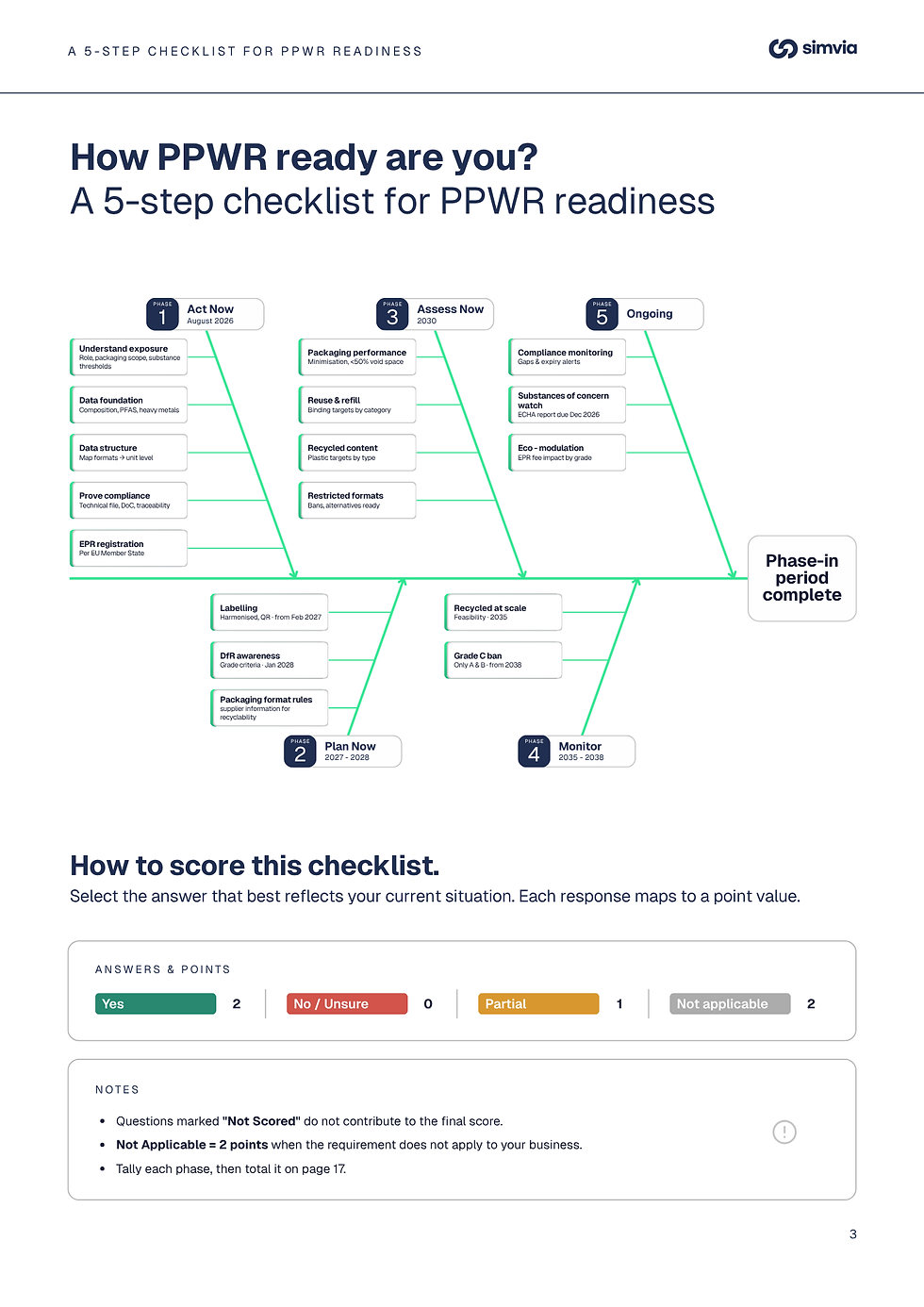
5-step PPWR checklist
18 pages
How PPWR ready are you? A 5-step checklist for PPWR readiness
From PFAS to format bans: one checklist to map every PPWR gap between now and 2040.
Phase 1 deep dive: everything due by August 12, 2026
Covers PFAS, heavy metals, DoC, labelling, recycled content and format bans
Self-assessment scoring: see if you land in the red, amber or green zone
Built for QA and packaging teams in consumer goods industry


Blog
Regulations
PPWR Readiness: Phase 4 Monitor 2035-2038
Phase 4 is a monitoring phase, not an action phase, but that doesn't mean it can wait. A ten-year runway sounds generous until you consider that material substitution and infrastructure development happen on a similarly long timescale.
Jul 22, 2026
Does PPWR apply to packaging made outside the EU?
Yes. PPWR applies to all packaging placed on the EU market regardless of where it was produced. Importers carry the same obligations as EU manufacturers — including verifying supplier compliance and retaining the technical file.
Is "non-intentionally added PFAS" still acceptable?
No. The thresholds apply regardless of intent. Recycled paper and board commonly contain PFAS from previous use cycles — "non-intentionally added" is not a valid defence. Actual measurement or verified third-party analytical data is required.
Who must issue the Declaration of Conformity?
The producer — the entity placing packaging on the EU market under its own name or trademark. If your brand name is on the pack, the DoC obligation is yours, even if a contract manufacturer produced it.
Can a packaging supplier refuse to share composition data?
Not lawfully. Article 16 of Regulation (EU) 2025/40 obliges suppliers to provide complete compliance information to downstream customers. A supplier who refuses is in breach of their own obligations.
In practice: if you cannot obtain the data needed to issue a DoC, you cannot lawfully place that packaging on the EU market.
What about packaging stock produced before August 2026?
Packaging already placed on the EU market before August 12, 2026 does not need to meet the new requirements. The cut-off is the date of placing on the market — not date of manufacture or sale. Managing stock and transition timing carefully is advisable for high-volume SKUs.
Who enforces PPWR and what are the real penalties?
Each Member State designates its own market surveillance authority. In the Netherlands it's the NVWA (typically €5,000–€50,000/week). In Germany, LUCID registration violations reach up to €200,000. Across all Member States, authorities can impose direct sales bans — including via marketplace platforms.