PPWR Regulation
AUGUST 2026
PPWR roles and obligations: what producers, manufacturers, importers, and distributors must to comply from August 2026.

Your PPWR role determines your obligations. Most food companies hold more than one role, and each role carries its own duties.

Each role carries distinct requirements from August. PFAS and heavy-metal limits, signed Declarations of Conformity(DoC), and EPR registration apply differently depending on whether you're the producer, importer, or distributor of a given product.

Knowing your PPWR role is the first step, not the last. Evidence collection, covering lab data, supplier documentation, Member State registration, takes weeks once your role is clear.
Still figuring out what PPWR actually requires from your team? You’re not alone. Here are the three things QA, Sustainability, and Packaging teams in F&B should know:

— Does this role apply to you?
Recognise your PPWR role.
Understand your responsibilities.
The PPWR assigns obligations by role, not by company type. The regulation defines separate PPWR roles: manufacturer, producer, importer and distributor. Most food compainess hold more than one PPWR role, depending on the product.
Producer
The manufacturer, importer, or distributor that first makes the packaging available in a specific Member State. A geography trigger, not a branding one — a different producer can apply per country for the same SKU.
Core obligations from August 2026
-
Register in that Member State's EPR/producer register
-
Report packaging volumes placed on the market
-
Pay EPR fees to a Producer Responsibility Organisation
Manufacturer
The person who manufactures packaging or a packaged product, or has it designed/manufactured under their own name or trademark. One manufacturer per packaging unit, EU-wide.
Core obligations from August 2026
-
Conduct conformity assessment
-
Issue EU Declaration of Conformity per packaging type
-
Maintain technical documentation (10-yr retention, producible within 10 days)
-
Hold lab-verified PFAS/heavy-metal data for food-contact packaging
Importer
EU-established person who brings packaging or a packaged product from outside the EU into the EU market for the first time.
Core obligations from August 2026
-
Verify PFAS/heavy-metal/labelling compliance before market entry
-
Hold a copy of the DoC (produce within 10 days)
-
Register in EPR schemes in every Member State sold into
-
Carry the same substance-compliance duty as the manufacturer
DIstributor
Anyone in the supply chain, other than the manufacturer or importer, who makes packaging available on the market.
Core obligations from August 2026
-
Verify the manufacturer/importer has met their obligations before selling on
-
Check labelling is correct and shows no signs of non-compliance
-
Maintain traceability of who supplied what
-
Never relabel or repackage without taking on full manufacturer obligations
Authorised Representative
An EU-established entity appointed in writing by a producer with no EU establishment, to handle EPR registration and reporting in a Member State on their behalf.
Core obligations by August 2026
-
Register the non-EU producer in the national EPR/producer register
-
Submit volume reports and EPR fee payments on the producer's behalf
-
Act as the compliance contact for that Member State

Most F&B businesses hold more than one role across their product range. A food brand that sells products under its own name is a producer for those SKUs. If it also sources packaged goods from outside the EU, it is an importer for those lines. If it resells a third-party branded product without modification, it acts as a distributor for that product. Your role is determined product by product — not once for the whole business. Mapping your role per SKU is the first step in any PPWR compliance process.


Whitepaper download
18 pages
Unpacking the PPWR: the complete guide for food and consumer goods
Everything QA, packaging and sustainability teams need in one document: every role, every deadline, every requirement — with a practical preparation checklist.

PFAs & heavy-metal requirements explained
Declaration of Conformity walkthrough
EPR registration by Member State
Step-by-step preparation checklist
F&B-specific examples throughout


PPWR SURVEY RESULTS
22 pages
How prepared is food and consumer goods industry for PPWR?
PPWR August 2026: now in force. Here's how the food industry is reacting, and how it's positioning itself.
35% average confidence scroe in PPWR readiness
49% indicated suppliers don't respond or are slow to reply
38% PPWR ownership sits solely within Quality Assurance
4 extra hours a week lost to compliance busywork.
F&B-specific examples throughout
Effective Aug 2026 · Food-contact packaging
What does this mean in practice:
A ready-to-eat salad bowl or sandwich wrap cannot be placed on the EU market from August 2026 if the packaging contains PFAS above legal limits. Moulded fibre bowls and paper-based wraps commonly use PFAS coatings to prevent grease and moisture from leaking through. Every packaging component requires laboratory testing, not just supplier statements.

PFAS limits in food-contact packaging
Maximum thresholds: 25 ppb per individual non-polymeric PFAS, 250 ppb for the total sum, and 50 ppm total fluorine. Covers any packaging in direct or indirect contact with food, including paper, board, and flexible laminates. "Non-intentionally added" is not a valid defence.
Effective Aug 2026 · All packaging types
What this means in practice?
A brightly printed outer carton or foil lidding with metallic inks could exceed thresholds even if the food-contact inner is clean. Every layer of a multilayer pack needs checking, not just the innermost surface.

Heavy-metal limits across all packaging
Combined concentration of lead, cadmium, mercury and hexavalent chromium must stay under 100 mg/kg for every packaging type, not just food-contact. Applies to inks, pigments, coatings and adhesives used in production.
Effective Aug 2026 · Producer obligation
What does this mean in practice?
A dairy brand with 80 SKUs across 12 different packaging types needs 12 DoCs, each supported by supplier data and lab evidence. Any material change, such as switching cardboard suppliers or coating specifications, triggers a DoC update. Outsourcing production does not transfer this obligation.

Declaration of Conformity per packaging type
The producer must issue, sign and retain a DoC for each unique packaging type. It must reference the specific PPWR requirements met, include material composition data, and be updated whenever the packaging changes.
Effective Aug 2026 → Feb 2027
What this means in practice?
For a co-packer producing F&B packaging under a retailer's label, the retailer's name and address must appear, not the co-packer's. Packaging ordered now without this field will need artwork and plate changes before the deadline.

Labelling & digital identifiers on-pack
From August 2026, packaging must display the manufacturer's name and address, or provide a QR code linking to it. From February 2027, digital identifiers must also carry material composition and recyclability information, replacing the Green Dot.
Criteria being finalised · Effective 2030
What this means in practice?
Black trays with carbon-black pigment, common in ready-meal packaging, are likely to grade D or E due to optical sorting limitations. Food packaging engineers should model recyclability grades now to avoid costly reformulation under time pressure.

PPWR recyclability requirements from 2030
All packaging will receive a recyclability grade against Design for Recycling criteria currently being finalised through EU implementing acts. From 2030, packaging graded D or below will be banned from the EU market. From 2038, only grades A and B will remain permitted. Design decisions made today determine readiness in 2029.
Effective Aug 2026 · Per member state
What this means in practice?
A Dutch food brand selling via Amazon Germany that hasn't registered in Germany's LUCID system is already non-compliant. Under PPWR: fines up to €200,000 and marketplace sales restrictions, with no grace period from August 2026.

EPR registration and fee payment
Producers must register in national EPR schemes in every Member State where they first place packaged goods on the market. Fee levels differ per country and material type. Missing or incorrect registration is an offence in its own right, with direct sales bans as a consequence.
— What are the PPWR requirements, specifically for food & consumer goods?
Six major requirements with real consequences for food operations.
What each PPWR obligation actually means for your QA, sustainability and packaging teams, with concrete examples from food operations.
— Your PPWR readiness timeline, from 2026 to 2030
Evidence collection takes longer than most teams expect. This PPWR timeline guides you through every stage and deadline.
August 12 has passed: operational systems should now be live. Below is the journey up to conformity today, and the longer programme that continues beyond it.
3 steps to PPWR Compliance
1. Compliance evidence & technical file readiness:
Supplier documentation, data verification, and audit-ready file maintenance.
2. Packaging redesign
Material selection, design modification, and structural changes to meet customer and regulatory requirements.
3. Reporting & fees
Identify roles and responsibilities and calculate fees

Compliance evidence
For many companies, the largest workload PPWR requires is managing compliance evidence. PPWR requires managing data and evidence across many suppliers, packaging formats and SKUs.
PPWR introduces a shift in sustainability regulation with obligations distributed across quality, procurement, packaging & sustainability teams
PPWR August 2026: Now in force
Start now
Define which PPWR roles you hold per product line.
Pakcaging baseline
Map components,suppliers, and initial structure
Evidence collection
Gather specs,declarations of conformity,and lab evidence
Compliance verification
Validate PFAS and heavy metals compliance
Compliance required
Prove complinace on authority request
After August 2026 - Long-term Obligations
August 2026
Substances of concern limits
General application- EPR requirements
Febuary 2027
Green dot moves to
QR code
2029
Deposit return schemes must collect 90% of in-scope containers
2030
Recyclability standards & targets are in place
Prohibited packaging types introduced
2035 & beyond
Recycled at scale requirement in effect
Higher recyclability standards, recycled content & reuse targets
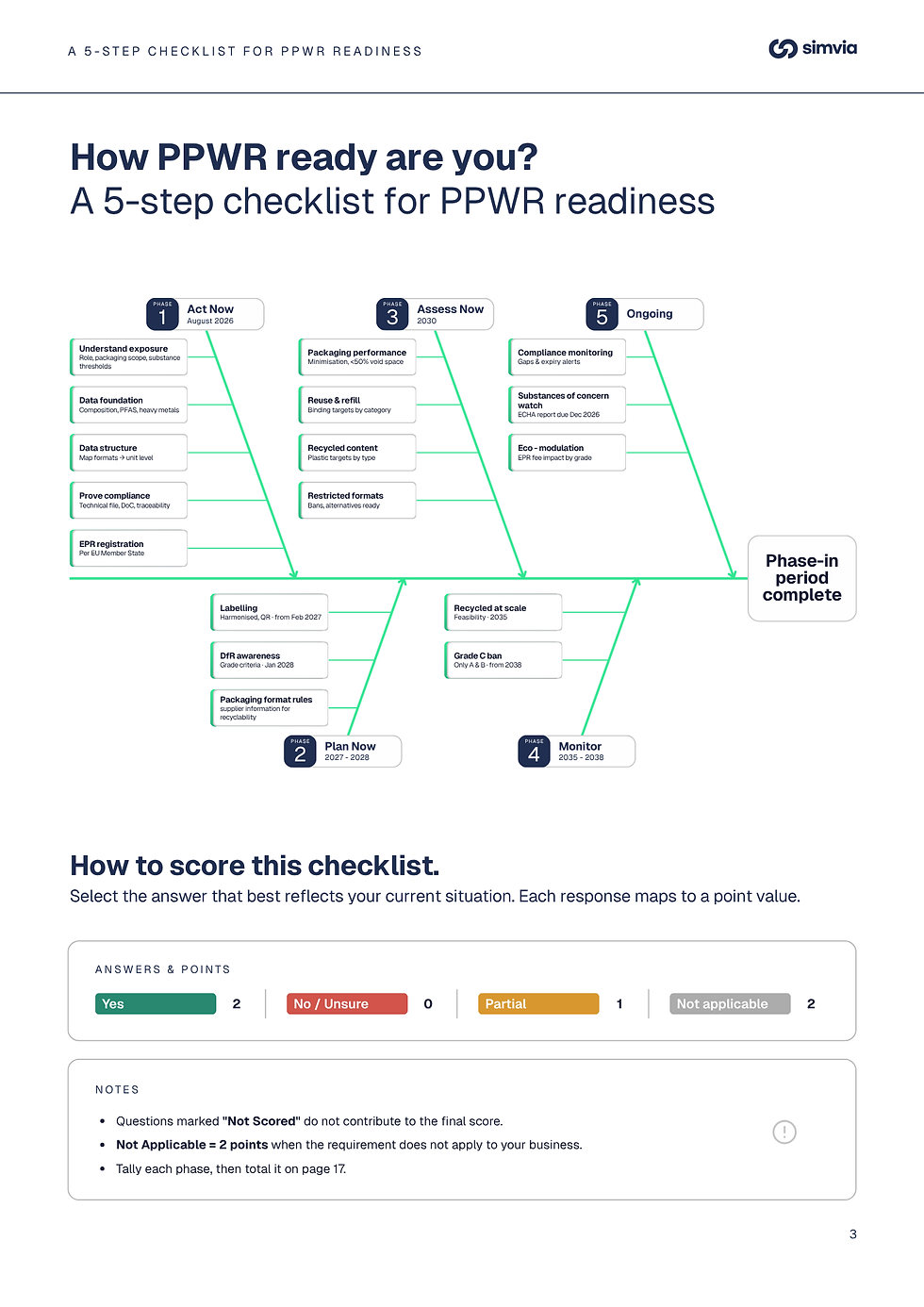
5-step PPWR checklist
18 pages
How PPWR ready are you? A 5-step checklist for PPWR readiness
From PFAS to format bans: one checklist to map every PPWR gap between now and 2040.
Phase 1 deep dive: everything due by August 12, 2026
Covers PFAS, heavy metals, DoC, labelling, recycled content and format bans
Self-assessment scoring: see if you land in the red, amber or green zone
Built for QA and packaging teams in consumer goods industry
Does PPWR apply to packaging made outside the EU?
Yes. PPWR applies to all packaging placed on the EU market regardless of where it was produced. Importers carry the same obligations as EU manufacturers — including verifying supplier compliance and retaining the technical file.
Is "non-intentionally added PFAS" still acceptable?
No. The thresholds apply regardless of intent. Recycled paper and board commonly contain PFAS from previous use cycles — "non-intentionally added" is not a valid defence. Actual measurement or verified third-party analytical data is required.
Who must issue the Declaration of Conformity?
The producer — the entity placing packaging on the EU market under its own name or trademark. If your brand name is on the pack, the DoC obligation is yours, even if a contract manufacturer produced it.
Can a packaging supplier refuse to share composition data?
Not lawfully. Article 16 of Regulation (EU) 2025/40 obliges suppliers to provide complete compliance information to downstream customers. A supplier who refuses is in breach of their own obligations.
In practice: if you cannot obtain the data needed to issue a DoC, you cannot lawfully place that packaging on the EU market.
What about packaging stock produced before August 2026?
Packaging already placed on the EU market before August 12, 2026 does not need to meet the new requirements. The cut-off is the date of placing on the market — not date of manufacture or sale. Managing stock and transition timing carefully is advisable for high-volume SKUs.
Who enforces PPWR and what are the real penalties?
Each Member State designates its own market surveillance authority. In the Netherlands it's the NVWA (typically €5,000–€50,000/week). In Germany, LUCID registration violations reach up to €200,000. Across all Member States, authorities can impose direct sales bans — including via marketplace platforms.


Blog
Regulations
PPWR Readiness: Phase 4 Monitor 2035-2038
Phase 4 is a monitoring phase, not an action phase, but that doesn't mean it can wait. A ten-year runway sounds generous until you consider that material substitution and infrastructure development happen on a similarly long timescale.
Jul 22, 2026